IPCC
Sixth Assessment Report — Food, Fibre and Ecosystems
The scientific consensus on climate impacts to food systems.
A research program investigating how passive cooling technologies may support agricultural resilience under extreme heat — across crops, livestock, workers, irrigation, storage and rural buildings.
Rising temperatures, more frequent heatwaves, water shortages and changing weather patterns are placing unprecedented pressure on agriculture. Around the world, farmers face declining yields, increasing crop stress and growing uncertainty. Cooling crops and reducing heat exposure is becoming an increasingly important strategy for protecting global food production.
Agriculture is one of the sectors most exposed to climate change.
Many crops evolved within relatively narrow temperature ranges. As global temperatures rise, even a few additional degrees during flowering, fruit development or grain filling can significantly reduce yields and crop quality.
Heat stress affects plant growth in many ways. Photosynthesis becomes less efficient, water demand increases, pollen viability declines, fruit set is reduced and crops mature more quickly — often before reaching their full yield potential.
Climate change is also increasing drought frequency in many regions, while warmer conditions accelerate evaporation from soils and irrigation reservoirs. Together these factors make farming increasingly difficult and expensive.
Protecting crops from excessive heat is therefore becoming an essential part of climate adaptation and future food security.
MEER is developing passive cooling technologies that reduce the solar energy absorbed by crops, agricultural infrastructure and surrounding surfaces — with the potential to reduce heat stress, lower irrigation demand and improve resilience without energy-intensive cooling systems.
Many crops lose a significant share of their yield when exposed to prolonged heat during critical growth stages.
Farms worldwide depend on increasingly unpredictable weather and water supplies.
Agriculture accounts for roughly 70% of global freshwater withdrawals.
Climate change threatens food security for billions of people through declining agricultural productivity.
Heat extremes are increasing across many of the world's major agricultural regions.
Higher temperatures reduce crop productivity and increase plant stress.
More evaporation and reduced rainfall increase irrigation requirements.
Hotter conditions dry soils more rapidly, increasing water demand.
Many crops experience reduced pollination during extreme heat.
Warmer climates let agricultural pests and diseases spread into new regions.
Floods, droughts and heatwaves increasingly disrupt harvests worldwide.
Select a crop to see how a warming climate is affecting its growing regions.
West Africa (Ghana, Côte d'Ivoire)
Rising temperatures and changing rainfall threaten cocoa production across the West African belt.
Hover or focus a crop to see the climate challenge it faces.
Passive cooling works alongside existing agricultural practices rather than replacing them.
Traditional agricultural adaptation has focused primarily on irrigation, drought-resistant crop varieties and changing planting schedules.
While these remain important, reducing the solar heat absorbed by crops, soils and agricultural infrastructure offers another powerful adaptation strategy.
Scientific and institutional evidence on climate change and food systems.
IPCC
The scientific consensus on climate impacts to food systems.
FAO
UN Food and Agriculture Organization on adaptation and resilience.
CGIAR
Global research partnership on resilient food systems.
Nature Food
Peer-reviewed research across food production and sustainability.
Our World in Data
Open data on yields, land use and agricultural emissions.
NASA Earth Observatory
Satellite observations of croplands, drought and growing seasons.
MEER is developing a range of passive cooling technologies designed to reduce heat stress across agricultural systems.
Our work includes reflective canopies, passive daytime radiative cooling (PDRC) materials, reflective mulches, reservoir cooling systems, high-albedo agricultural infrastructure and other approaches that lower temperatures while reducing water demand.
By preventing excessive solar heating before it reaches crops, soils and agricultural environments, these technologies have the potential to improve yields, conserve water and strengthen resilience as the climate continues to warm.
MEER's agricultural work is at an earlier stage than our urban rooftop research. Most applications on this page sit in concept research, laboratory development or early prototype testing. We are investigating how the same core physics — reflection, emission and shading — can be engineered for the very different conditions of a working farm.
Nothing on this page should be read as a finished agricultural product. It should be read as a description of an evolving research program.
Farms sit on the front line of climate change. Adapting agriculture to a hotter world will require a mix of tools. MEER is researching whether — and how — surface-cooling technologies can be part of that mix.
Many staple crops lose yield sharply above specific temperature thresholds — often before drought stress even sets in.
Bare and dark soils amplify daytime heat around plants and animals, well above the ambient air temperature.
Extended heat exposure affects flowering, pollination, ripening and grain fill in ways that cumulative averages hide.
Outdoor agricultural labor is among the most heat-exposed work on the planet, with rising health and productivity risks.
Heat stress reduces feed intake, milk yield, fertility and welfare across most livestock systems.
Higher surface temperatures accelerate evaporation from soils, irrigation systems and open water bodies.
Any credible cooling response has to think at multiple scales at once — from a single plant, through a whole field, out to the infrastructure and buildings that make farming possible.
Microclimate around individual plants — leaves, canopy layer, root zone temperatures.
Land surface temperature across whole fields; heat loads on soil, workers and equipment.
Buildings, storage, livestock housing, irrigation infrastructure and shaded working areas.
Interaction with reservoirs, canals, rural settlements and regional heat patterns.
Each application is investigated as its own engineering problem. The stage badges show where the work currently sits — most is still in early research or prototype testing.
Research into modular reflective canopies that reduce peak leaf and soil temperatures during the hottest hours while allowing enough light through for growth.
Investigating how reflective roofs and PDRC coatings on animal housing can reduce heat stress and improve welfare in warmer regions.
Research into reflective covers and floating systems for irrigation ponds and canals to reduce evaporation and surface warming.
Shaded rest and working areas for outdoor labor, combining canopies with reflective ground surfaces to reduce radiant heat exposure.
Cooling of grain stores, cold chain facilities and post-harvest buildings using reflective and radiative treatments on roofs and walls.
Research into selective reflective materials that manage heat load inside protected growing environments without compromising photosynthetically useful light.
Homes, workshops and community buildings in agricultural regions — the same reflective and PDRC systems used in urban work adapted for rural stock.
[ Ongoing research and development ]
A flexible, low-cost approach to reducing heat exposure across farmland.
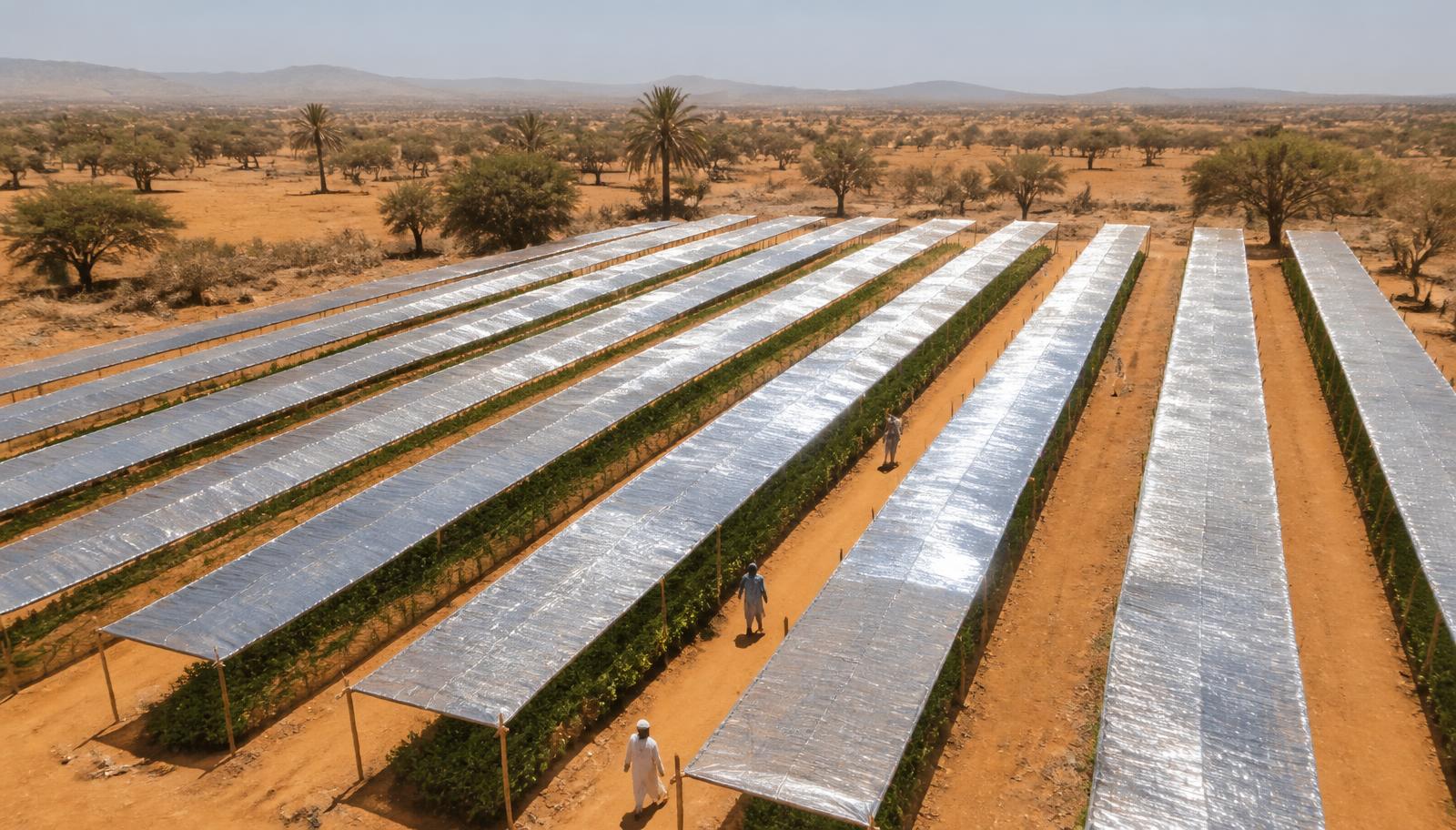
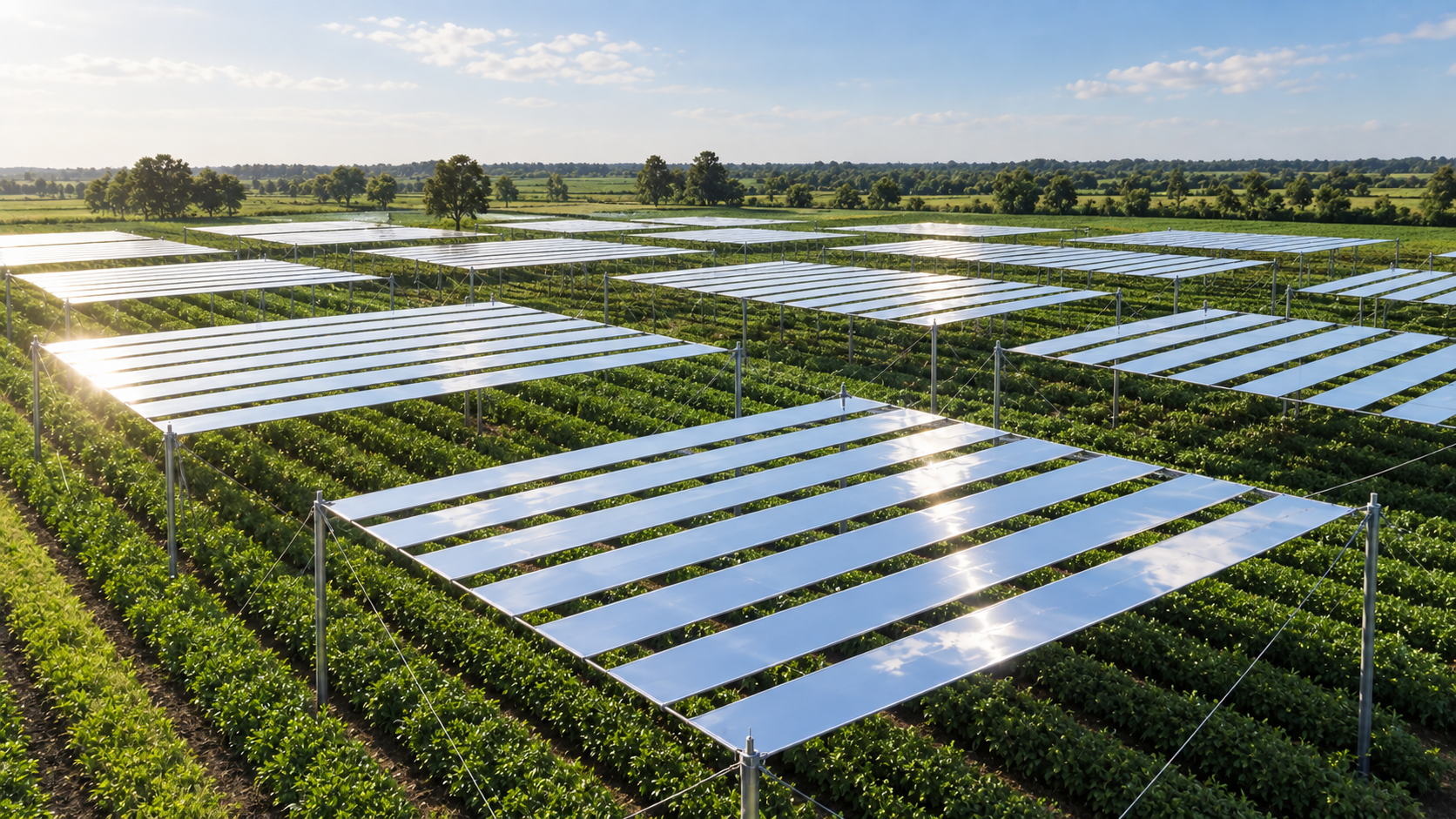
Modular reflective canopy systems are being explored as a flexible approach to reducing heat exposure in agricultural environments. Individual canopy sections can be deployed where protection is most needed, helping create cooler working areas and reducing radiant heat over selected crops.
Because each module stands alone, coverage can be adapted to different farming systems — concentrated over nurseries and harvesting areas, spread across sensitive plots, or moved as the growing calendar shifts. This is an area of active research rather than a commercial product.
Individual canopy sections can be placed where protection is most needed, then reconfigured as the season changes.
Shaded, high-albedo cover creates cooler places to work, rest and handle produce during the hottest hours.
Selected plots can be covered to lower radiant heat over crops that are most vulnerable to heat stress.
The same modular units can serve a smallholding or be repeated across larger agricultural sites.
Cooling comes from reflection alone — no pumps, fans or external energy supply are required.
Spacing, height and coverage can be tuned to different climates, crops and farming systems.
[ How it works ]
MEER is investigating modular reflective canopy systems as a potential way to reduce heat exposure in agriculture. Research is focused on understanding how reflective canopy technologies could support worker wellbeing, crop resilience and climate adaptation across a range of agricultural environments.
[ One subset of reflective agriculture ]
Reflecting incoming solar radiation to create cooler growing conditions for protected crops.
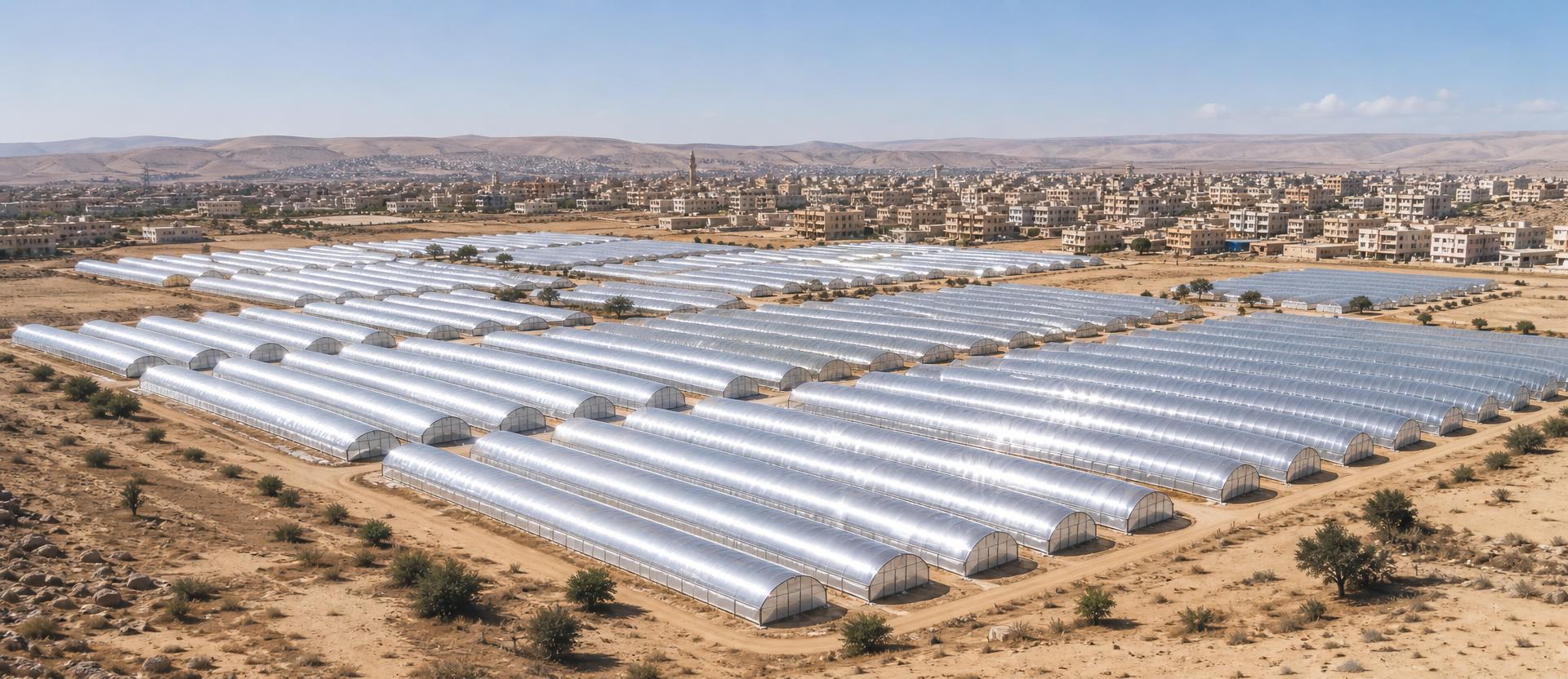
MEER is researching highly reflective agricultural tunnel systems that combine advanced reflective coverings with sustainable structural materials, including bamboo where appropriate. These systems are designed to reduce solar heat gain while maintaining productive growing conditions for selected crops.
This is deliberately a narrow case. Reflective crop tunnels suit only certain crops in certain climates, and they are one of many possible approaches to reflective agriculture — not the primary mitigation pathway for agricultural surfaces as a whole.
Less solar load reaching the canopy during the hottest hours of the day.
Highly reflective coverings turn away incoming solar radiation before it becomes heat inside the tunnel.
Cooler growing environments reduce evaporative losses and irrigation demand.
Supporting frames may be built from bamboo or other locally available sustainable materials, depending on regional requirements.
[ How it works ]
Reflective growing tunnels are one line of enquiry within MEER's broader work on reflective agricultural surfaces — alongside reflective mulches, shade structures, and field-scale albedo management. The emphasis remains on the reflective surface technology itself; supporting frames may be constructed from bamboo or other locally available sustainable materials, depending on regional requirements.
Concept research — not an existing large-scale deployment.
[ Protecting people on the farm ]
Providing cooler working environments for agriculture in a warming world.
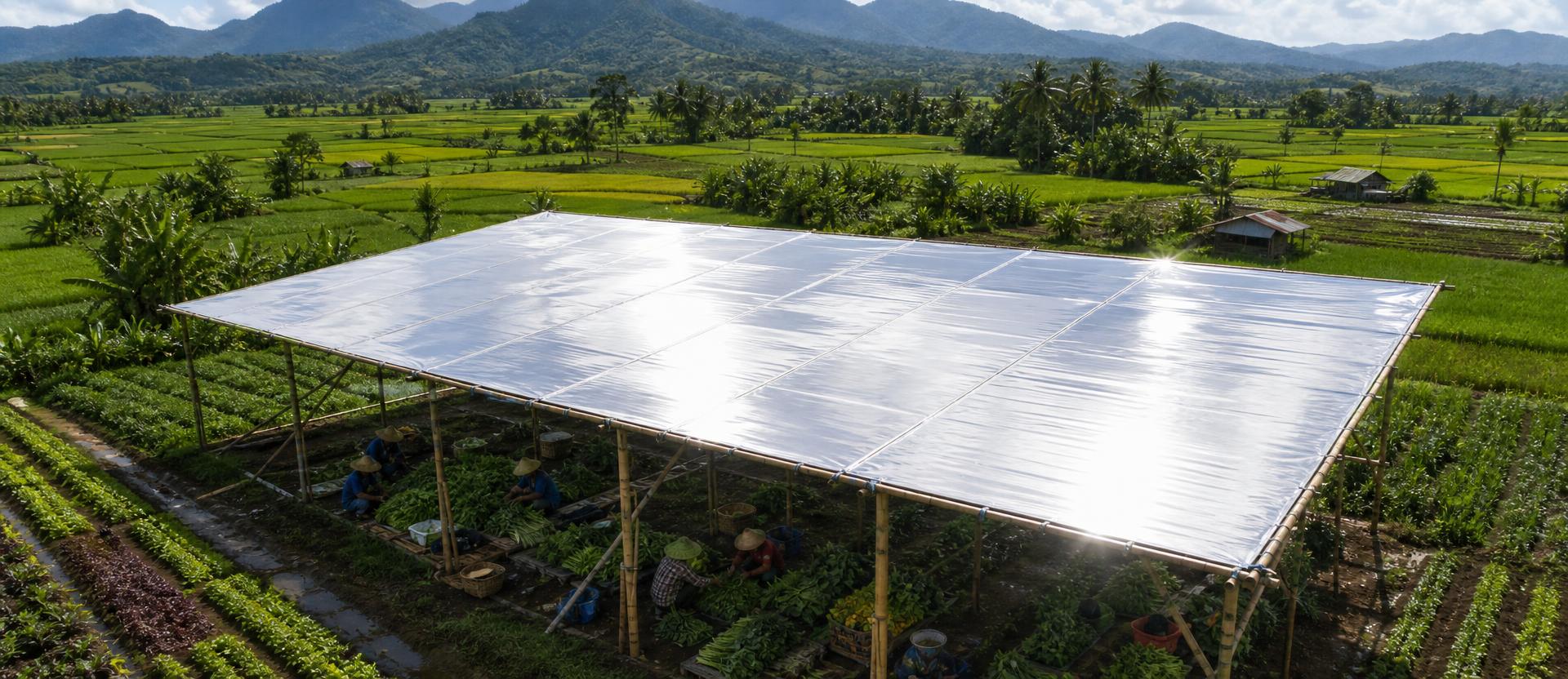
Outdoor agricultural labor is among the most heat-exposed work on the planet. MEER is researching how simple, low-cost shelters built from bamboo frames and highly reflective canopy material could give farmers shaded places to harvest, sort, pack, rest, and meet.
The aim is not to replace existing farm buildings, but to add flexible, rapidly deployable cooling where workers need it most — without mechanical air conditioning or heavy infrastructure.
Deep shade plus a reflective upper surface lowers the heat load on farmers during the hottest hours of the day.
Cooler rest and work areas reduce fatigue, support longer safe working windows, and protect vulnerable workers.
The high-albedo canopy reflects solar radiation before it is absorbed and re-radiated toward people below.
A simple bamboo frame and modular reflective covering can be assembled with locally available materials and skills.
[ How it works ]
MEER is exploring highly reflective canopy systems for agricultural shelters that could help protect farmers from extreme heat while supporting more resilient and sustainable food production. Design questions — including bamboo frame durability, canopy tensioning, wind resistance, and cost at scale — are still under investigation.
Lightweight reflective panels raised on bamboo frames are being studied as a way to shade stored irrigation water, lowering the solar energy it absorbs and slowing evaporation through the hottest months.
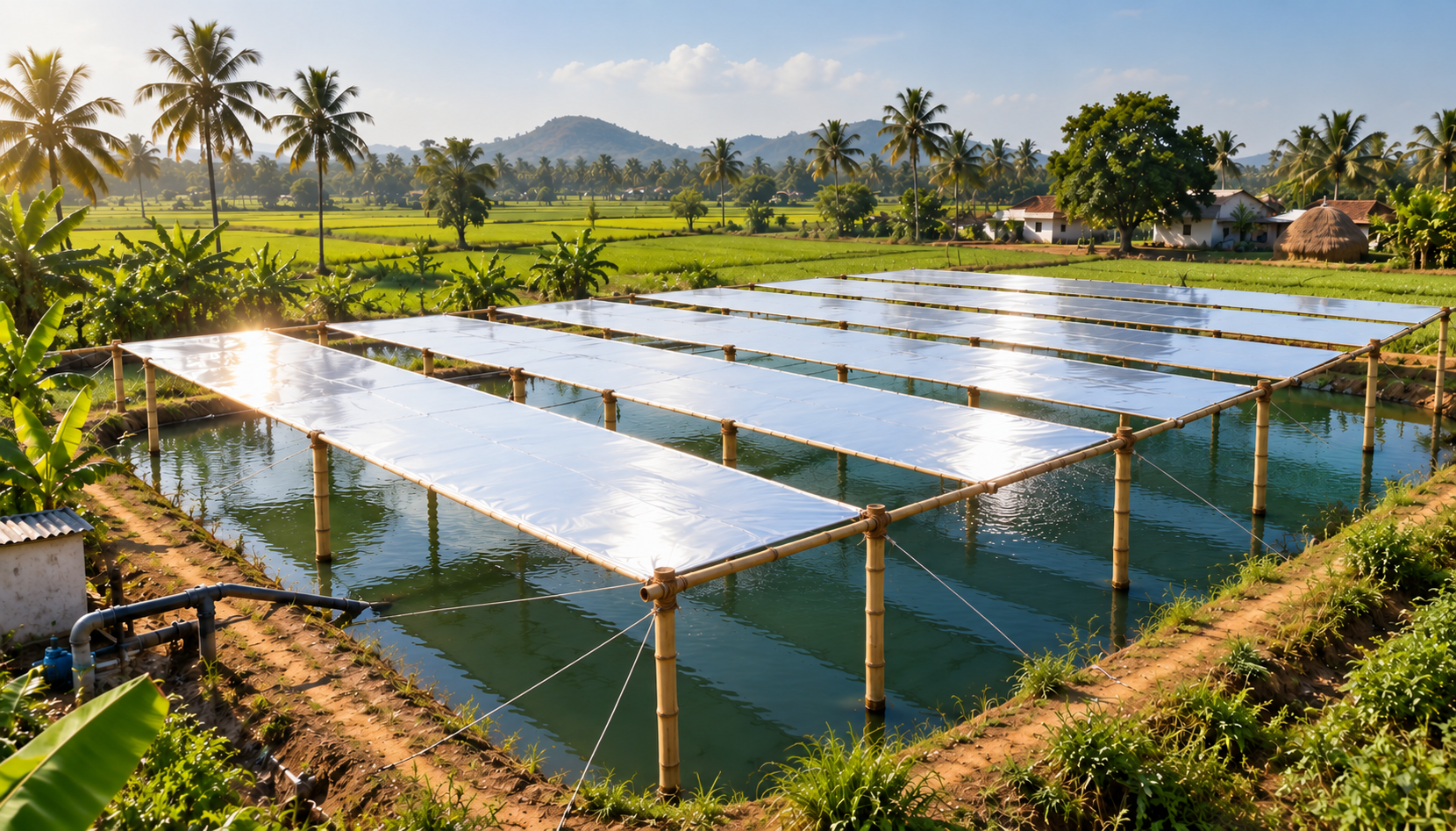
The underlying physics — reflection of sunlight and emission of thermal radiation — is identical to MEER's urban work. What changes is the engineering: modularity, ease of installation, durability against wind and dust, compatibility with agricultural operations.
Rather than repeating the technology descriptions here, we treat this page as a study of how our existing portfolio may be adapted for agricultural conditions.
Modular reflective canopies adapted for fields, workshops and animal housing — allowing engineered shade without permanent structures.
The same high-albedo treatments used in cities, applied to rural buildings, storage facilities and animal housing.
Passive daytime radiative cooling materials that keep coated surfaces cooler than the surrounding air even in direct sun.
Concept research into floating covers for irrigation ponds and reservoirs to reduce both evaporation and surface heating.
Ongoing work into how these systems can be manufactured, installed and maintained in rural and low-infrastructure environments.
Instrumented field measurement of surface temperature, air temperature and productivity indicators alongside every deployment.
Rather than waiting until laboratory work is “finished” before engaging with the real world, MEER develops, tests, measures and refines agricultural cooling systems through an iterative loop of scientific research and real-world validation.
We move from concept, through the laboratory, into engineered prototypes and instrumented field trials. Nothing on this page should be read as a finished commercial product unless explicitly described that way elsewhere on the site.
The full research and engineering portfolio — including the technologies being adapted for farms.
ExploreResearch into reflective floating systems for reservoirs, canals and irrigation infrastructure.
ExploreWhy the reflectivity of a surface is central to any cooling strategy.
ExploreHow PDRC materials emit heat past the atmosphere into cold space.
ExploreHow different cooling approaches compare on energy in versus cooling delivered.
ExplorePeer-reviewed and open publications from the MEER research program.
ExploreIf you are a farmer, researcher, agronomist or partner interested in field-testing passive cooling in agricultural environments, we would like to hear from you.